
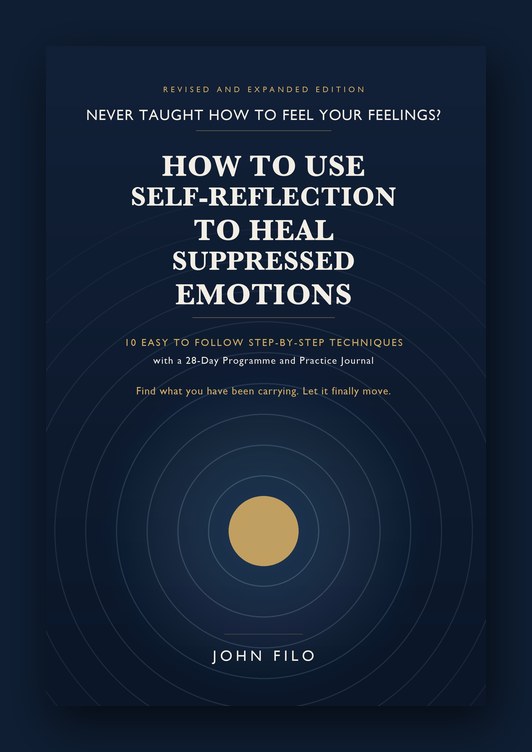
A 10-step self-reflection method, explained simply
Most of us were never taught how to work with a difficult feeling — only how to carry it quietly. This 220-page guide teaches ten specific, learnable techniques for reflective journaling and meditation, one step at a time.
Also on Kindle Unlimited. Ships worldwide from Amazon.
This book is educational. It is not therapy, and not a substitute for professional medical or psychological care.
- ✓10 techniquesnumbered, step by step
- ✓60 secondsa short version of each
- ✓28 daysa day-by-day programme
- ✓Practice journalworksheets & 90-day tracker
A great many people were never taught how to work with a difficult feeling — only how to carry it quietly.
If nobody ever taught you how to feel your feelings, you are in very good company. It is one of the most common things in the world and one of the least often spoken about. The feelings do not disappear; they go underground and keep running.
It tends to show up in ways like these:
- Crying at films and advertisements, and rarely at one's own life.
- Saying "I'm fine" and meaning it a little less each year.
- Feeling numb at exactly the moments one most wants to feel something.
- Being exhausted by a life that looks fine on paper.
- The smallest thing landing far harder than it should.
Feelings you refuse to feel do not disappear
They go underground and keep running. That is why you can be exhausted by a life that looks fine on paper. It is why the smallest thing can set you off. It is why you can feel numb at exactly the moments you most want to feel something.
You learned, a long time ago and probably in a house where it was the safest thing to be, to push feelings down before they could finish. It worked. It protected you. It simply never switched itself off.
There is no shortage of advice about emotions. Be present. Let it go. Feel your feelings. If none of it ever told you how, that is the gap this book fills.
The ten techniques
Five writing techniques and five stillness techniques. Each one gets its own chapter, and every chapter follows the same shape, so you always know what you are doing next.
Writing techniques
- Stream of Consciousness Journaling
- Reflective Journaling
- Gratitude Journaling
- Affirmation Journaling
- Writing Letters to Yourself
Stillness techniques
- Breath and Anchor Meditation
- Body Scan Meditation
- Loving-Kindness Meditation
- Visualisation Meditation
- Mindfulness Meditation
Every chapter contains: what the technique is, why it works, a sixty-second version for hard days, the full practice laid out step by step, what you might feel, what to do when it does not work, and how to adapt it to your own life.
What else is in the book
A 60-second version of every technique
For the days you have almost nothing to give. Three minutes is a real practice, and it is where everyone starts.
Honest troubleshooting
What to do when a practice does nothing at all — or brings up considerably more than you expected.
A five-stage method
One repeatable way of working with a single difficult emotion, which you can use inside any of the ten techniques.
A 28-day programme
Tells you exactly what to do each day, if you would rather not have to choose for yourself.
A complete practice journal
Worksheets, questions organised by emotion, and a 90-day tracker — all in the back of the book.
Straight answers about when self-help is not enough
What to look for, and how to find real help, without pretending a journal fixes everything.

John Filo
Most people do not need more theory about their emotions. They need a specific thing to do, on an ordinary Tuesday, in the twenty minutes they actually have.
John Filo is a teacher, writer and healer whose work focuses on self-reflection as the practical foundation of emotional and spiritual growth. After years of carrying emotions he could not name, and a period of illness that finally forced him to look at them, he began the practice that became this book — and has spent the last ten years teaching it to others.
He is the father of three daughters and writes from Australia.
Start with three minutes
You do not have to believe it will work. You only need enough willingness to try one small thing and see what happens.
Paperback
- 220 pages, 6 × 9 trade paperback
- The complete practice journal and worksheets
- The full 28-day programme
- Read it, write in it, keep it
Ships worldwide from Amazon
Kindle
- Reads on any Kindle, phone or tablet
- Start the first technique in two minutes
- Included in Kindle Unlimited
- The cheapest way to begin
Delivered instantly by Amazon
Read the first technique free
Leave your email and I will send you The 60-Second Reset — the short version of Technique 1, plus the five-stage method for working with a single emotion. It is the fastest way to find out whether this approach is for you.
No spam, no daily email, and you can unsubscribe in one click.
This book is not therapy
It says so plainly, and it tells you where to go instead.
Please contact your local emergency services or a crisis line in your country immediately if you are having thoughts of harming yourself or another person. This is not a situation for a journal.
Speak to your doctor or a qualified mental health professional if:
- what surfaces in a session does not settle over the following days, or gets worse rather than moving
- you have a significant trauma history and these practices are bringing material up rather than helping it move
- you are using alcohol, drugs, food, gambling or anything else to manage how you feel
- you are not sleeping, not eating, or not able to work or care for the people who depend on you
- your mood has been low or anxious for more than a few weeks
- you have been diagnosed with a mental health condition, or are taking medication for one
- your own instinct keeps telling you that you should not be doing this alone
It is entirely reasonable to start this work and then decide you need more support. That is not failing at the book. That is the book working.
How to Use Self-Reflection to Heal Suppressed Emotions: 10 Easy to Follow Step-by-Step Techniques, with a 28-Day Programme and Practice Journal. Revised and Expanded Edition. Copyright © 2023, 2025 John Filo. All rights reserved. ISBN 9798385659005.
This book and this page are for general information and to support your emotional and spiritual well-being. They are not a substitute for professional medical or psychological care, and nothing here is medical advice. If you are in crisis, please contact your local emergency services or a qualified crisis line in your country right away.